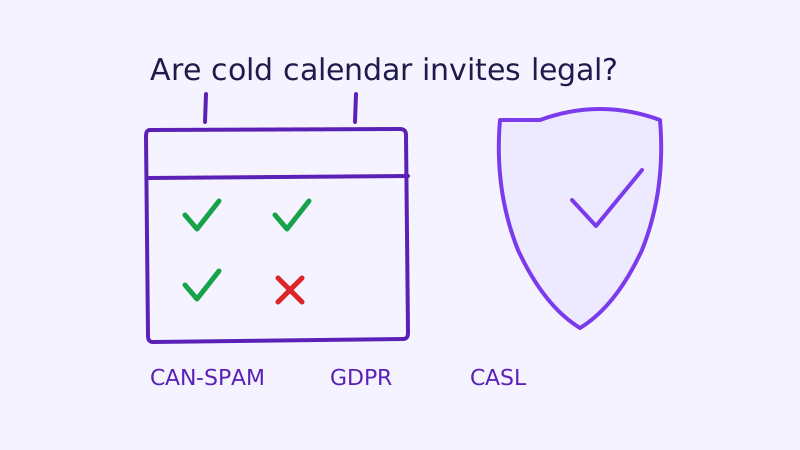
Before a sales leader signs off on a cold calendar invite program, someone in the room asks the question that stalls a lot of good outreach ideas: is this even legal? It is the right question to ask, and the honest answer is that calendar invites occupy a slightly different legal space than cold email, with rules that vary by where your prospect sits.
This guide walks through the three frameworks that matter most for B2B outreach into North America and Europe: CAN-SPAM in the United States, CASL in Canada, and GDPR across the European Union and United Kingdom. None of this is legal advice, and you should run any program past your own counsel, but understanding the shape of each rule helps you design campaigns that hold up.
Why calendar invites are not “just email” under the law
Most outreach regulation was written with marketing email in mind. A calendar invite is a transactional object: it is an .ics file delivering an event with a time, a place, and an organizer. When a prospect accepts, declines, or even sees the invite, they are interacting with a scheduling artifact rather than reading a promotional message.
That distinction matters because several laws draw their hardest lines around “commercial electronic messages” whose primary purpose is to advertise or promote. An invite to a specific meeting is closer to a request to connect than to a broadcast advertisement. But the line is not absolute. If you stuff the invite description with a sales pitch, links, and promotional copy, you start to look like the very thing those laws were built to govern. The safest framing is simple: the invite proposes a meeting, not a product.
This is also why Kali treats the invite as a lightweight, personal touch rather than a newsletter dressed up as an event. The closer your invite stays to a genuine meeting request, the cleaner your compliance posture.
CAN-SPAM (United States)
CAN-SPAM is less restrictive than people assume. It does not require prior consent to send commercial messages. What it requires is honesty and an exit:
- No deceptive headers or subject lines. The “from,” “to,” and routing information must be accurate, and the subject must reflect the actual content.
- A clear way to opt out. Recipients must be able to tell you to stop, and you must honor that request promptly.
- A valid physical postal address. Commercial messages need to identify the sender with a real mailing address.
- Identification as an ad where applicable. If the message is promotional, that should be reasonably clear.
For calendar invites, the practical takeaway is to keep the organizer identity truthful, include a real way to decline future contact, and avoid burying a sales pitch behind a misleading event title. An invite titled “Quick intro: [Your Company] and [Their Company]” with a one-line description and your real contact details is far easier to defend than a vague title hiding a promotion.
CASL (Canada)
CASL is the strict one. Canada generally requires consent before sending a commercial electronic message, and that consent is either express or implied. Implied consent can come from an existing business relationship, a recent inquiry, or a conspicuously published business email address where the message relates to that person’s role.
Because the bar is higher, calendar invite outreach into Canada should lean on legitimate grounds: an existing relationship, a recent interaction, or a clearly published business contact relevant to the meeting you are proposing. CASL also requires sender identification and a working unsubscribe mechanism, and the penalties for getting it wrong are significant. If Canada is a meaningful part of your market, treat consent as a gating step rather than an afterthought.
GDPR (EU and UK)
GDPR is not an anti-spam law; it is a data protection law. It governs how you collect, store, and use personal data, including the business email addresses and names you load into an outreach campaign. Two ideas do most of the work:
- Lawful basis. You need a legal reason to process someone’s personal data. For B2B outreach, “legitimate interests” is the usual basis, but it requires a genuine balancing test: your interest in reaching a relevant decision maker, weighed against their reasonable expectations and rights.
- Transparency and rights. People have the right to know who has their data, why, and to object or request deletion. Your invite outreach should make it easy to opt out and should connect back to a privacy notice.
The ePrivacy rules layered on top of GDPR add consent requirements for certain electronic marketing in some member states, and national interpretations differ. The defensible pattern for invite outreach into Europe is tight targeting (reach people whose role makes the meeting genuinely relevant), a documented legitimate-interests assessment, accurate sender identity, and a frictionless way to opt out.
Data hygiene is part of compliance
Every framework above assumes you actually know who you are contacting. Sending invites to stale, scraped, or role-based addresses is both a deliverability problem and a compliance risk: you are processing data you cannot vouch for and contacting people who never expected to hear from you.
This is where list quality does double duty. Validating your contact data before a campaign reduces bounces and spam complaints, and it also tightens your data-protection story by removing addresses you have no business contacting. Running your list through an email validation tool like Scrubby before you send keeps invalid and risky addresses out of the campaign, which protects both your sender reputation and your compliance footing. Clean data is the unglamorous foundation under every rule in this article.
A practical compliance checklist for invite campaigns
You do not need a legal degree to run a defensible program. You need discipline:
- Identify yourself honestly. Real organizer name, real company, accurate event title, no spoofed headers.
- Keep the invite a meeting request. A short, specific reason to meet beats a paragraph of promotion.
- Make opting out effortless. Honor declines and stop-contact requests quickly, and keep a suppression list.
- Target on relevance. Reach people whose role makes the meeting plausible, which strengthens both legitimate-interest arguments and your reply rates.
- Document your basis by region. Note why you can contact a given segment under the rules that apply to them.
- Clean your list first. Remove invalid, risky, and irrelevant addresses before the first invite goes out.
- Keep records. Track consent signals, suppression requests, and your reasoning, so you can show your work if asked.
The bottom line
Cold calendar invites are not a loophole around outreach law, and they are not banned by it either. They are a legitimate channel that, used honestly and with good targeting, fits comfortably inside CAN-SPAM, CASL, and GDPR when you respect the spirit of each: be truthful about who you are, give people a clean way out, contact people for whom the meeting is genuinely relevant, and treat their data with care.
Do that, and the compliance question stops being a blocker and becomes a checklist. The teams that win with invite outreach are the ones that treat respect for the recipient as both the legal strategy and the conversion strategy, because the two point in the same direction.