Sales teams ran to LinkedIn for the same reason they are now running to cold calendar invites: the email inbox stopped working. Reply rates fell, spam filters tightened, and the channel that built a generation of outbound businesses started returning less every quarter.
So teams went where the attention was. LinkedIn DMs felt like a fresh channel with a captive audience. For a while, they were. But the same crowding that killed cold email has been arriving on LinkedIn, and a different channel, the cold calendar invite, has been quietly outperforming both on the only metric that matters: meetings booked.
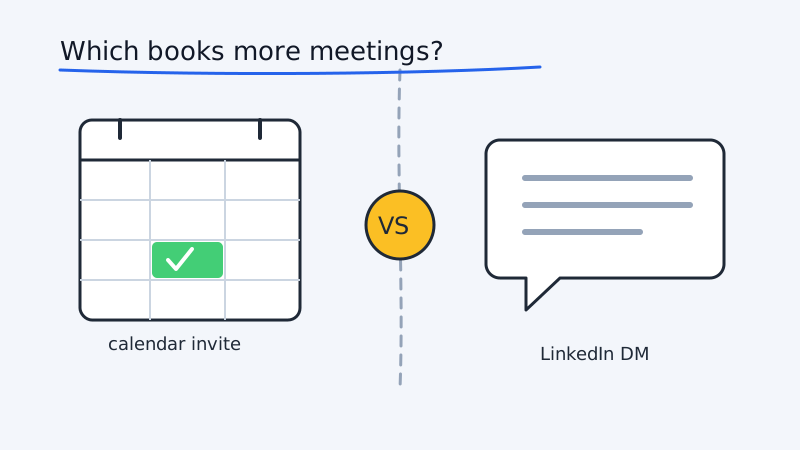
This is a direct comparison of the two. Not which one feels modern, but which one actually gets time on a prospect’s calendar.
How each channel actually works
A LinkedIn DM lands in a prospect’s LinkedIn inbox. To send one without paying for InMail, you usually need a connection first, which means a connection request, an acceptance, and then a message. The prospect reads it inside an app they may check daily or weekly, surrounded by other pitches, recruiter spam, and notifications.
A cold calendar invite lands as a meeting request directly on the prospect’s calendar, with a proposed time, an agenda, and a clear next step. Instead of asking “would you be open to a chat sometime,” it presents a specific slot the prospect can accept, decline, or propose a change to. It shows up in the one tool every professional treats as a source of truth: their calendar.
That structural difference drives almost everything about how the two channels perform.
Where LinkedIn DMs win
LinkedIn has genuine strengths, and pretending otherwise sets you up to misuse it.
Research and context are built in. You can see a prospect’s role, tenure, posts, and mutual connections before you write a word. That makes personalization easier and references warmer.
Warm paths are visible. Shared connections, recent job changes, and engagement on their posts give you legitimate, non-creepy reasons to reach out.
It is social, not transactional. A thoughtful comment on someone’s post before a DM builds familiarity that a cold channel cannot. For relationship-led, longer sales cycles, that warmth compounds.
The weaknesses are just as real. Connection requests cap out and get throttled when you scale. Acceptance is a gate before you can even pitch. And the channel has been flooded, so the median DM now reads as obvious automation and gets ignored or reported. Worst of all, a DM still asks for a meeting in vague terms, which leaves the prospect to do the work of deciding when, replying, and scheduling.
Where cold calendar invites win
The calendar invite’s advantage is that it collapses the gap between interest and action.
It removes scheduling friction entirely. A DM that lands well still needs a back-and-forth to find a time. An invite already proposes one. The prospect’s decision shrinks from “do I want to reply, negotiate a time, and commit” down to a single click: accept or decline.
It arrives in a high-trust, low-noise environment. Calendars are not flooded with pitches the way inboxes and DMs are. An invite stands out precisely because almost nobody uses the channel for outreach yet.
It signals seriousness. Proposing a specific time with a clear agenda reads as confident and respectful of the prospect’s time, not as a fishing expedition.
The catch is that calendar invites demand precision. A vague or spammy invite is more jarring than a bad DM, because it is on a more personal surface. The agenda has to be sharp, the timing considerate, and the targeting tight. Done carelessly, the channel backfires. Done well, it converts interest into a booked meeting faster than anything else in outbound. Running it at scale without it feeling like spam is the entire problem Kali is built to solve, by handling the targeting, timing, and personalization that make a cold invite land as professional rather than presumptuous.
The head-to-head
| Factor | LinkedIn DMs | Cold calendar invites |
|---|---|---|
| Friction to a booked meeting | High (request, accept, reply, schedule) | Low (accept the proposed slot) |
| Channel crowding | Rising fast | Still low |
| Built-in research context | Strong | Limited, must bring your own |
| Scaling limits | Connection and message caps | Scales with clean data |
| Risk if done poorly | Ignored or reported | Jarring, hurts brand |
| Best for | Relationship-led, longer cycles | Direct, time-sensitive meeting asks |
Which one books more meetings?
For the specific goal of booking a meeting now, cold calendar invites win, because they remove the steps where LinkedIn DMs leak interest. Every extra action you ask a prospect to take, accept a request, reply, propose a time, is a place the deal cools. The invite compresses all of that into one decision.
But “which books more meetings” is the wrong question if you treat it as a permanent either-or. The strongest outbound programs use both in sequence. LinkedIn is where you build context and warm a prospect through a comment or a light touch. The calendar invite is the close, the moment you convert that warmth into a specific time. The DM earns the right to send the invite, and the invite captures the meeting the DM alone would have left dangling.
And both channels rest on the same foundation as cold email: the quality of your data. A calendar invite to a stale or wrong contact is wasted, and a high bounce or mismatch rate signals sloppiness on a very personal surface. Validating your target list before you run invites, with a tool like Scrubby, protects the channel’s biggest advantage, which is that it still feels personal and rare.
The takeaway
LinkedIn DMs are a relationship channel that has gotten crowded. Cold calendar invites are a closing channel that is still uncrowded and removes the friction where meetings get lost. If you only had one move, the invite books more meetings. If you want a complete motion, use LinkedIn to earn attention and the calendar invite to convert it, on clean data, every time.