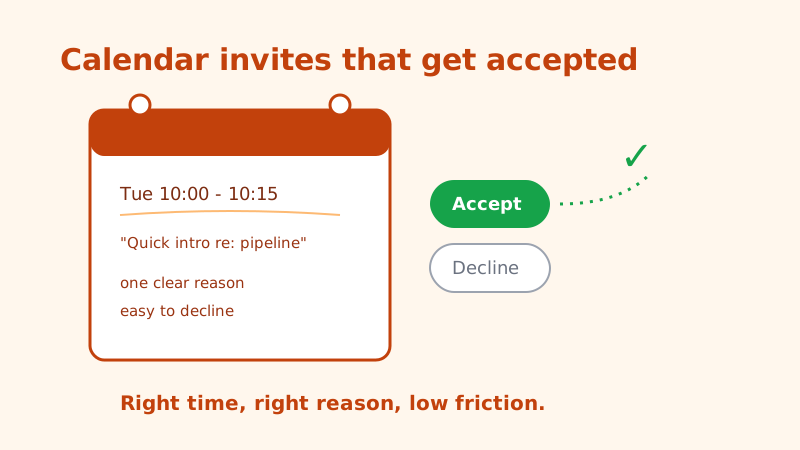
A cold calendar invite is a different object than a cold email. It shows up in the prospect’s calendar, not their inbox, which means it skips the spam folder and the “mark as read” reflex entirely. But that same directness raises the bar on the message. An invite asks for a yes or no decision right now, so the note inside it has to earn that decision in about two seconds of reading.
Below are five templates that consistently get accepted, plus the structure they all share and the mistakes that get invites declined on sight.
The structure every good invite note follows
Before the templates, the pattern. A high-acceptance invite note does four things, in order:
- Names a relevant reason. Not “to connect,” but a specific, prospect-side reason this 15 minutes is worth their time.
- Stays short. Three to four sentences. The calendar already carries the time, date, and duration, so the note only has to carry the why.
- Makes declining easy. A line that gives them an obvious out lowers the perceived pressure, which counterintuitively raises acceptance.
- Sets a tiny, concrete agenda. People accept meetings they can picture. “I’ll walk you through X, you tell me if it’s relevant” beats an open-ended ask.
Every template below is just this skeleton with different muscle.
Template 1: The relevant-trigger invite
Use when you have a real signal (funding, a hire, a launch, a job posting).
Hi [Name], saw [company] just [trigger, e.g. opened 4 SDR roles]. Teams scaling outbound that fast usually hit the same wall around deliverability and meeting volume. Booked 15 minutes Tuesday to share how we have seen others handle it, no slides. If the timing is off, decline and I’ll send the short version by email instead.
Why it works: the trigger proves you did homework, and the “decline and I’ll email” line removes the cost of saying no.
Template 2: The peer-proof invite
Use when you serve a recognizable segment.
Hi [Name], we help [3 named or describable peers] book more demos without leaning harder on cold email. Put 15 minutes on Thursday to show you the exact play they use. If it is not a fit you will know inside five minutes and can drop off. Worst case you walk away with one tactic.
Why it works: social proof plus a guaranteed takeaway makes the downside of accepting feel like zero.
Template 3: The short-and-direct invite
Use for senior prospects who hate fluff.
[Name], 15 minutes on [date] to see if [your category] is worth your time this quarter. I’ll be specific and quick. If not relevant, hit decline, no follow-up.
Why it works: it respects their time by modeling the behavior, and it explicitly promises no nagging, which removes the main reason people ignore invites.
Template 4: The re-engagement invite
Use to revive a stalled or gone-quiet deal.
Hi [Name], we talked back in [month] and the timing was not right. A few things have changed on our side that address what you flagged about [their objection]. Grabbed 15 minutes [date] to show you, no restart of the whole process. If it is still not the moment, decline and I’ll check back next quarter.
Why it works: it references the prior context, names their specific objection, and promises not to make them sit through the full pitch again.
Template 5: The value-first invite
Use when you can lead with something useful regardless of outcome.
Hi [Name], I pulled a quick teardown of how [competitor or peer] is running their outbound and where the gaps are. Happy to walk you through it live, 15 minutes [date]. Yours to keep either way. If you would rather just have the doc, decline and I’ll send it.
Why it works: the meeting is framed as the delivery mechanism for something they already want, not as a pitch with a value wrapper.
The mistakes that get invites declined
- Sending at the wrong time. An invite that lands for a slot two hours from now reads as presumptuous, and one three weeks out gets forgotten. Mid-morning, two to four business days ahead, tends to land best. (We dug into invite timing in depth separately, but the short version is: give them room without going cold.)
- No reason, or a seller-side reason. “To introduce our platform” is about you. Reframe to what they get.
- A wall of text. If the note needs scrolling, it gets declined. The calendar entry is not the place for your full value prop.
- No easy out. Invites that feel like a trap get declined out of self-defense. Counterintuitively, the line that offers an exit is the line that earns the yes.
- Sending to a dead address. If the invite bounces, none of this matters. Run your list through a validation layer like Scrubby first so your invites reach real inboxes and your sending domain stays healthy.
Make the channel do the heavy lifting
Templates get you the acceptance. The reason to use calendar invites at all is that they sidestep the inbox crowding that is dragging cold email response rates down across B2B. The note earns the yes, but the channel is what gets you in front of the prospect in the first place. Running invites at scale with proper timing and personalization is exactly what Kali is built for, so you can send these templates as a campaign instead of one calendar entry at a time.
Start with Template 1 if you have a trigger and Template 3 if you do not. Keep the note short, give an easy out, and let the calendar carry the rest.