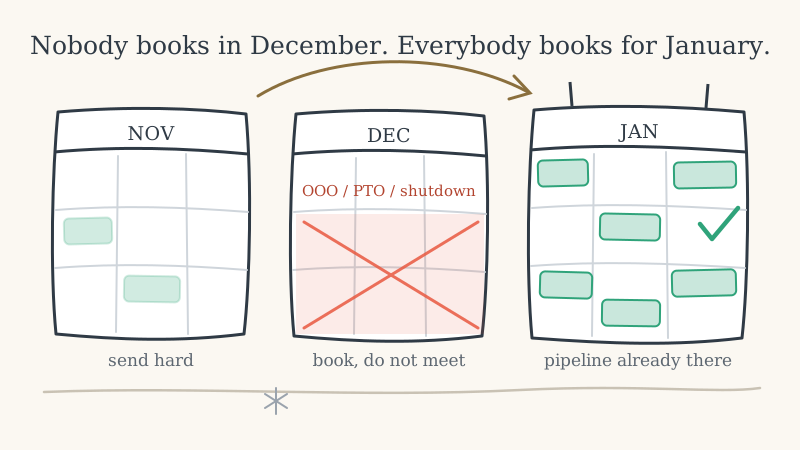
Every outbound team tells itself the same story in the second week of November. Buyers are checked out. Budgets are frozen. Nobody wants a meeting in December. We will pick it back up in January.
Then January arrives and the calendar is empty, because pipeline that should have been created in November and booked in December was never created at all. The quarter opens with a cold start, the team spends three weeks prospecting from zero, and the first real meetings land in February. One sleepy six week stretch turns into a missed Q1.
The teams that beat this do not work harder in December. They change what they are asking for, and they change it on a schedule. This is a seasonality playbook for cold calendar invite outreach: what the holiday calendar actually does to your acceptance rate, which weeks to push, which weeks to go quiet, and how to use the one asset the holidays hand you for free, which is the fact that your prospect’s January is visibly, embarrassingly empty.
What the holidays actually do to outbound (and what they do not)
The common belief is that buyer attention collapses in December. That is only half right, and the half that is wrong is the expensive half.
What actually happens is that buyer availability collapses while buyer intent stays flat or rises. Two different things, two different responses.
Availability collapses for mechanical reasons. People take PTO. Companies run shutdown weeks between Christmas and New Year. Working parents inherit two weeks of school holidays. Internal planning offsites eat whole days. The number of meetable hours in the last three weeks of December is a fraction of a normal month, and no amount of persuasive copy creates an hour that does not exist.
Intent does not collapse, because the thing driving intent in Q4 is the opposite of a vacation. Budgets for next year are being finalized in November and December. Tooling decisions deferred all year get revisited because somebody has to spend or justify the line item. New headcount plans get approved, and whoever is getting that headcount is also thinking about what the team will run on. A buyer who ignored you in August is, in late November, actively deciding what next year looks like.
So the December problem is not that nobody wants to talk. It is that you are asking for the one thing they genuinely cannot give you, which is time this week. The channel that handles this split best is the one that negotiates in units of calendar time rather than units of attention, because a calendar invite can be dated anything you want. That is the entire mechanic behind cold calendar invite outreach: the invite lands on the prospect’s calendar and stays visible even when the email itself goes unread, and the prospect accepts with one click. In Q4, the click you are asking for is not “meet me now.” It is “hold this slot in January.”
The Q4 calendar, week by week
Treat the quarter as four distinct sending regimes, not one long slog.
Weeks of early to mid November: push harder than normal. This is the single best window of the year for booking, and most teams underuse it because they are mentally already in holiday mode. Buyers are at their desks, budget conversations are live, and the competitive noise in the inbox is lower than it will be in January. Send at full volume. Date your invites inside the next seven to ten days. This is normal outbound with better than normal conditions.
The week of Thanksgiving in the United States: cut volume, do not stop. Monday and Tuesday are real working days and are quieter than usual, which cuts both ways: fewer competing meetings, but also a lot of people already traveling. Run at roughly half volume, skip Wednesday through Friday entirely for North American lists, and keep European and APAC segments at normal volume because the week means nothing to them. If you run a single global list with one schedule, this is the week that teaches you to segment it.
Early December: the last real meeting window, and the start of the pivot. The first two weeks of December still contain plenty of bookable hours, and buyers who want a decision before the year closes are motivated. Keep sending, but start dating a portion of your invites into mid January rather than next week. You are running two offers in parallel: meet now if you have the budget urgency, hold a slot if you do not.
The last two weeks of December: stop asking for December. Stop dating invites inside the shutdown window entirely. An invite that lands on a day the prospect is out does not get declined politely, it gets deleted along with the rest of the noise, and you have burned a touch for nothing. Shift fully to January dating. Volume can stay moderate, because the ask is cheap to say yes to. Nothing is being taken from them this month.
The dead week between Christmas and New Year: go quiet. Not reduced, quiet. Almost nobody is reading, calendars are not being managed, and anything you send is competing with an auto responder. The only exception is a small, deliberate push on the second and third of January, which lands exactly as people reopen their laptops and start planning the month.
Why the January ask converts better than the December ask
The pivot from “meet this week” to “hold a slot in January” is not a softer ask. In practice it is an easier yes for three reasons that compound.
The first is that the cost of agreeing is lower when the cost is far away. A 15 minute meeting on Thursday competes with everything else on Thursday. A 15 minute meeting on January 14 competes with almost nothing, because January 14 is currently empty. Agreement feels cheap, which is exactly what you want from a first touch.
The second is that your invite is, briefly, the only thing in an empty room. For most of the year you are trying to wedge into a dense week. In the last weeks of December you are placing a block onto a page with nothing else on it. When the prospect opens their calendar in the first week of January to plan the month, your meeting is sitting there as one of the few things already scheduled. That is a visibility advantage you cannot buy in March.
The third is that January is when the stated intent of Q4 becomes a real obligation. The buyer who said in November that they would “look at this next year” committed to something, and the calendar is where that commitment either exists or does not. If your meeting is on the books, you are part of their January plan. If you are a note in their inbox, you are part of the backlog they will declare bankruptcy on.
None of this works if the follow up collapses over the break, which is the usual failure point. An invite accepted on December 18 for a meeting on January 14 has a four week gap in it, and a four week gap with no contact produces a no show. This is where the show up mechanics matter more than the booking mechanics. KALI sends AI personalized follow ups to prospects who have not responded and AI personalized show up reminders before every booked meeting, which is what keeps a long dated January meeting from quietly evaporating over the holidays. The full managed motion is built around that: the list syncs in, invites go out personalized from real buying signals, and the reminders and follow ups are handled rather than left to a rep who is also on PTO.
Four practical adjustments for Q4 sending
Segment by holiday calendar, not by region as you normally define it. Your usual territory split is probably wrong for this quarter. What matters in Q4 is which holidays a prospect observes and when their company shuts down. United States Thanksgiving, European August style December closures, Japanese New Year, and Australian summer holidays all land differently. One global send schedule guarantees you are sending into dead air for some portion of your list every week of the quarter.
Date invites further out than feels comfortable. Most reps instinctively date an invite two to four days out because closer feels more urgent. In December, further out is the entire advantage. Dating three or four weeks ahead is not weakness, it is the only way to put the meeting somewhere the prospect can actually attend it.
Do not try to make up December volume with December urgency. Year end deadline language (“before budgets reset,” “last chance this year”) reads as manufactured to anyone who is not already in a buying cycle, and it is the first thing a skeptical buyer discounts. If there is a genuine year end reason to move, say it plainly once. If there is not, do not invent one. The January slot ask does not need urgency to work, which is precisely why it survives the season.
Protect your sending infrastructure through the quiet weeks. Volume that drops to zero and then spikes back to full in the first week of January is a worse sending pattern than a steady moderate taper, and a brand new or poorly warmed sending account is especially exposed to a sharp January ramp. If you are running this in house, taper rather than cliff, and ramp back up across several days rather than all at once. If you want the warmup, volume ramp, and sender reputation handled rather than managed by a rep in the middle of a holiday, that is part of what a managed calendar outreach service is for.
Measuring the quarter without fooling yourself
Q4 metrics lie if you read them the way you read a normal month, and the lie goes in both directions.
Acceptance rate on a January dated invite sent in December will usually look good, sometimes better than your baseline, for the reason described above: cheap yes. Do not read that as a step change in your targeting or your copy. It is a seasonal effect on the ask, and it will revert.
The number that tells you whether the quarter worked is meetings held in the first three weeks of January, counted against what you booked in December. That single ratio contains both the booking and the show up problem, and it is the only Q4 metric with a real consequence attached. A team that books forty January meetings in December and holds twelve of them did not win the quarter, it generated a reporting artifact. A team that books twenty five and holds eighteen has started Q1 with real pipeline.
Track the long dated gap explicitly. Segment your December bookings by how far out they were dated, and look at attendance by bucket: one week out, two to three weeks, four weeks or more. The attendance decay curve across that gap is the most useful thing you will learn all quarter, and it will tell you exactly where your reminder cadence needs to be tighter next year. If you want the baselines to compare against, our acceptance rate benchmarks are the non seasonal reference point, and the difference between acceptance rate and show rate matters more in December than in any other month, because the gap between the two is at its widest when the dates are furthest out.
One more thing worth measuring: what your quiet weeks cost you. Teams that go fully dark from December 15 through January 5 are giving up three weeks of booking capacity against a January that they will then spend prospecting into. Compare the cost of a moderate holiday send against the cost of a February first meeting, and the arithmetic usually argues for keeping the lights on.
The short version
Q4 is not one season, it is four. November is your best booking month of the year and most teams sleep through it. Thanksgiving week is a volume cut, not a stop. Early December still books real meetings for people with real year end pressure. Late December stops asking for December and starts asking for January, which is an easier yes than anything you can ask for in a normal month.
The holidays do not remove buyer intent. They remove buyer hours. A channel that trades in calendar dates rather than inbox attention can work around missing hours, because the date is a variable you control. That is the whole opportunity, and it closes on about January 6.
If your current outbound is built entirely on cold email, this quarter is where the weakness shows most clearly: you are asking for attention in the six weeks of the year when attention is scarcest, and asking for nothing that survives a two week absence. KALI runs the calendar invite motion as a managed service, with first meetings typically landing within five to seven days of launch, which means a campaign started in November is booking January pipeline well before your competitors have finished writing their Q1 sequences. The side by side against cold email is worth reading before you plan the quarter.