Selling into the nonprofit sector looks easy from the outside. There are roughly 1.8 million registered tax exempt organizations in the United States, most of them are visibly underserved by technology, and nearly every one of them publishes the names and email addresses of its leadership on a staff page. Your total addressable market is enormous and your contact data is free.
Then you start sending, and nothing comes back.
The reason is not that nonprofits do not buy. They buy donor databases, grant management software, volunteer platforms, accounting services, insurance, payment processing, marketing help, and consulting, every year. The reason is that the person who signs off on that purchase is probably the single most overloaded buyer in B2B. An executive director at a twelve person organization is simultaneously the CEO, the head of HR, the board liaison, the chief fundraiser, and the person who answers the main phone line. A development director is carrying an annual revenue target with a team of one. Neither of them has a gatekeeper to screen vendor email, which sounds like good news until you realize it means your message lands in the same inbox as a major donor’s question, a board member’s request, and a grant deadline notification. It loses every time.
This playbook covers how nonprofit technology and services sales teams use cold calendar invites to get on the books with executive directors, development leaders, and operations managers who will never answer a cold email.
Why standard outbound fails against nonprofit buyers
Four structural features of the sector break traditional prospecting.
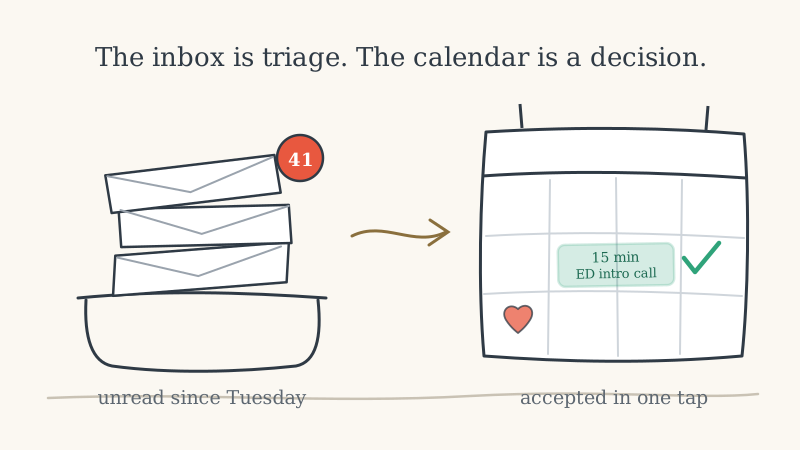
The inbox is a triage queue, not a channel. A for profit VP of ops has an assistant, filters, and a mental category for vendor pitches that she scans once a week. A nonprofit executive director has none of that. Her inbox is her actual to do list, and it is sorted by mission urgency. Your product email is not competing with other vendor emails. It is competing with a donor who needs a thank you letter and a program crisis. You are not being rejected. You are being passed over, repeatedly, by someone with a genuinely better use of the next ten minutes.
Phone outreach lands on a shared line. Main numbers at small organizations are answered by whoever is nearest, often a part time coordinator or a volunteer. Direct dials for leadership are rarely published, and mobile numbers almost never. Cold calling the sector burns hours to reach the wrong person.
The buying group is wide and informal. An executive director usually needs some combination of a development director, a program lead, an operations manager, a finance volunteer, and in meaningful purchases a board committee. There is no procurement function to route you, so the path to approval is whichever relationships you can build by hand. That makes multi-threading across the account more important here than in most mid-market deals, not less.
Timing is dictated by the fiscal and giving calendar, not your quarter. Most organizations do the bulk of their fundraising between October and December, close books on a June 30 or December 31 fiscal year, and set budgets in the quarter before. Reaching out with a platform pitch during year end giving season is a guaranteed no, regardless of fit, because the entire staff is executing the campaign that funds next year.
Cold calendar invites address the first two directly and give you a cleaner instrument for the last two. They land on a different surface than the triage inbox, they do not require a direct dial, and they ask for a decision small enough that an overloaded leader can make it in four seconds on a phone.
What a cold calendar invite actually is
A cold calendar invite is a real calendar event sent to someone you have not spoken with yet. It shows up in Google Calendar or Outlook the same way a board meeting or a site visit would: a title, a proposed time, a short description, and a video link. The recipient accepts, declines, or proposes a different time with one tap.
The advantage is the surface. An executive director who leaves forty vendor emails unopened will still look at anything that appears on her calendar, because a calendar entry implies a pending commitment she has to resolve. That built in prompt to respond is exactly what a cold email lacks. KALI reports invite acceptance rates in the 8 to 12 percent range against the 1 to 3 percent reply rates typical of cold email, and the gap is largest with buyers whose inboxes are the least defended and the most flooded. If the format is new to you, the primer on what cold calendar invite outreach is covers the mechanics.
Used properly it is not a trick, and that matters more in this sector than any other. Nonprofit leaders talk to each other constantly, across local funder networks, state associations, and national conferences. A manipulative invite costs you more than one meeting. A clear and respectful one reads as what it is: here is who I am, here are the fifteen minutes I want, here is what you get, take this slot or name a better one.
Step one: give the invite a reason tied to mission capacity, not features
The fastest way to waste this channel is a vague invite. An event titled “Platform Introduction” from an unrecognized name reads like spam that skipped the queue and gets declined on sight.
Every invite needs a reason stated in the organization’s own terms, and in this sector those terms are almost always capacity rather than efficiency. Commercial buyers respond to revenue and cost. Nonprofit buyers respond to what the purchase lets them stop doing by hand so they can serve more people. The strongest framing is time returned to the mission.
Segment and write accordingly:
- Executive directors care about staff hours, board reporting, audit readiness, and whether a new system will survive the next leadership transition.
- Development directors care about donor retention, lapsed donor reactivation, average gift size, and the hours lost to manual acknowledgment and reconciliation.
- Operations and finance leads care about restricted fund tracking, grant reporting deadlines, and integrations with whatever accounting package they already run.
- Program directors care about outcome measurement, because their funders now require it.
So write for the segment. Not “15 min to walk through our platform.” Instead: “15 min on cutting gift acknowledgment time before year end,” or “how three food banks your size handle restricted fund reporting,” or “15 min on lapsed donor reactivation ahead of your spring appeal.” When the reason names a task the leader already dreads, the invite stops reading as a pitch and starts reading as a peer who understands the work.
Two specifics give you an unfair advantage here, and both are public. Form 990 filings tell you an organization’s revenue, program expense ratio, fiscal year end, and often its named leadership. Annual reports and campaign pages tell you what they are currently raising for. Referencing one real detail from either lifts acceptance more than any amount of copy polish. If you are entering the sector for the first time, the walkthrough on using cold calendar invites to break into a new vertical covers building that segmented motion from nothing.
Step two: respect the calendar you are writing into
Timing decides more outcomes in this sector than copy does.
Avoid the last two weeks of December entirely. Avoid the week of any gala or major event you can see on the organization’s public calendar. Avoid the two weeks before a June 30 or December 31 fiscal close. The best windows are mid January through April, and late summer, when leadership is actually planning rather than executing.
Within the week, aim mid morning on a Tuesday, Wednesday, or Thursday. Keep the duration genuinely short. Fifteen minutes is far easier for someone with no slack in their day to accept than thirty, and once you are in the conversation you can earn the longer working session. The general patterns in our analysis of when to send calendar invites for maximum acceptance hold here, with the sector calendar layered on top.
Keep volume low and deliberate. This is not a channel for blind mass sending, and nonprofit lists punish it harder than most: staff pages go stale fast in a sector with high turnover, role addresses like info@ and development@ are read by nobody in particular, and bounces into a tired domain drag down placement for every organization you try to reach afterward. A rep working a focused list of a few hundred named leaders at well matched organizations will book more meetings than someone blasting ten thousand addresses scraped from a directory. Our breakdown of how many cold calendar invites to send per day covers safe pacing, and KALI handles sending account warmup and volume ramp on its own infrastructure so the sending reputation is not your team’s problem to manage.
Step three: write the invite so an overloaded leader accepts
Three elements decide the outcome: the title, the time, and the description. A nonprofit leader reads all three in about four seconds, on a phone, between two other things.
The title is your subject line and should name the outcome, not your company. “15 min: gift acknowledgment before year end” beats “Intro to our donor platform.” Keep it short enough to read in full in a notification.
The description closes the distance between a stranger and an accepted meeting. Two or three sentences maximum: who you are, the specific outcome you want to cover, and one concrete proof point, ideally a comparable organization by size and subsector. “We do this for four regional food banks in the 2 to 5 million range” lands. “Trusted by thousands of nonprofits” does not, because this buyer has been burned by a vendor who only understood large national organizations.
Then make declining and rescheduling obviously easy, and say so in a line. A leader who trusts that no costs her nothing is far more willing to say yes. Counter proposals are a win, not a rejection, and in this sector they are common because the calendar genuinely is the constraint.
Step four: follow up without adding to the pile
Most non responses here are not disinterest. They are an invite that arrived during a grant deadline.
That changes what follow up should look like. Do not re send the same invite with more urgency. Change one variable at a time: a different proposed time, a different named outcome, or a different person on the team. If the executive director does not respond twice, the development director often will, and an internal forward from a colleague carries more weight than anything you can send from outside. The sequencing in our guide on what to send after an unaccepted invite applies directly, stretched to a slower cadence to match the sector.
Then protect the meetings you book. Show rates in the nonprofit sector suffer from genuine emergencies rather than indifference, so a reminder before the meeting is doing real work, not nagging. KALI sends AI personalized follow ups to non responders and show up reminders before every booked meeting, which is where its reported 35 to 45 percent attendance on booked meetings comes from. The tactics in our piece on reducing no show rates are worth applying as written.
How to know whether it is working
Track acceptance rate, show rate, and meetings per sending account per week, and watch them by subsector rather than in aggregate. Human services, arts and culture, education, healthcare, and faith based organizations behave differently enough that a blended number hides the signal. Expect a longer path from first meeting to closed deal than your commercial segment, because board and committee approval is real. Judge the channel on qualified meetings created, not on deals closed inside the quarter. Our framework for measuring calendar invite outreach ROI lays out the reporting.
One more comparison worth running: hold your calendar invite numbers against whatever your email sequences are producing into the same list. The sector is where the gap tends to be widest, for the simple reason that the inbox is the most contested surface a nonprofit leader owns and the calendar is the least. The side by side on calendar invites versus cold email is the right scoreboard.
Where to start
Pull a list of 200 organizations that match your best existing customers on subsector and revenue band, using 990 data to filter rather than guessing from a website. Find the named executive director and development director at each. Write two invite reasons per persona, grounded in one public detail from their annual report or campaign page. Propose fifteen minutes, mid morning, midweek, outside year end giving season. Send a modest number per day and let the data tell you which reason works.
The sector is not hard to sell into because nonprofits do not buy. It is hard because the buyer’s attention is spoken for by a mission, and the inbox is where that gets settled. Put the meeting on the calendar instead. KALI runs the whole motion as a managed service, from personalized invites through AI follow ups and show up reminders, which is usually the difference between a channel a rep tests for two weeks and one that produces meetings every week. See the features for what the managed side covers, or the pricing page for how engagements are structured.