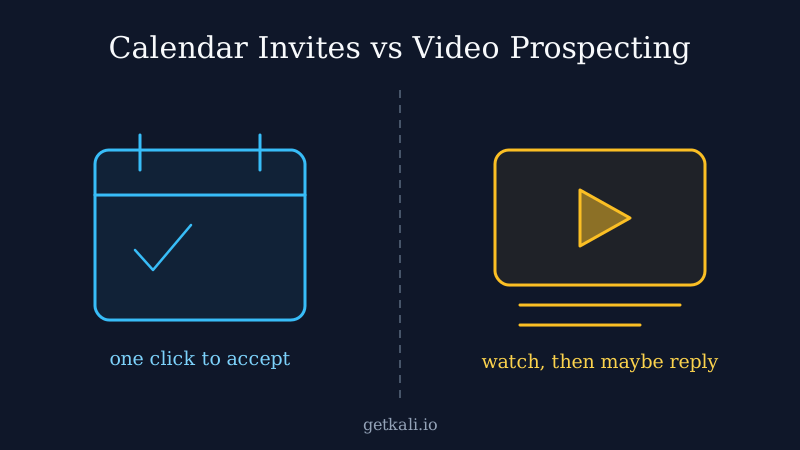
Video prospecting had a great run. Somewhere around 2020, every sales influencer was telling reps to fire up a webcam, record a thirty second Loom, and stand out from the wall of plain text emails. For a while it worked. A talking head waving at a whiteboard with the prospect’s name on it was genuinely novel, and novelty converts.
Then everyone did it. Now a video thumbnail in a cold inbox is about as surprising as a “quick question” subject line. The prospect still has to click, wait for the page to load, and watch a stranger talk before they learn whether any of it is relevant to them. That is a lot of asking before any giving.
Cold calendar invites flip that order. They do not ask the prospect to invest first. They put a concrete, low effort decision in front of them: accept, decline, or propose a new time. This guide runs both channels through the same scorecard, including effort asked of the prospect, reply and acceptance rates, how well each one scales, and the situations where one clearly wins.
The core difference: who spends effort first
Every outbound channel is a trade. You are asking for the prospect’s attention, and in return you promise something worth their time. The channels differ mostly in when the prospect has to spend effort and how much.
Video prospecting front loads the cost. Before the prospect knows whether your pitch is relevant, they have to:
- Notice the video and trust it is not malware.
- Click through to a hosting page.
- Wait for it to load.
- Watch you talk for thirty to ninety seconds.
- Only then decide whether to reply.
That is five steps, and four of them happen before the prospect receives any value. The drop off compounds at every step. Even a strong video with a 40 percent play rate loses most of its audience before the call to action.
Cold calendar invites ask for one decision. The invite shows up in the prospect’s calendar with a clear title, a short description, and three buttons: yes, no, maybe. There is no page to load and no monologue to sit through. The prospect reads one line and makes one choice. Tools like Kali are built around this single click model precisely because removing steps removes drop off.
This is not an argument that video is bad. It is an argument that effort asked of the prospect is the hidden variable most teams ignore when they compare channels.
Scorecard: effort, reply rate, and scale
Let us put the two channels side by side on the metrics that actually drive booked meetings.
Effort asked of the prospect
Video prospecting asks for sustained attention, up to a minute or more, before any value is delivered. Calendar invites ask for a single binary decision that takes under three seconds. Lower asked effort means less drop off, especially for senior prospects who guard their time aggressively.
Winner: calendar invites.
Reply and acceptance signal
Video prospecting replies are rich. When someone responds to a good video, they are often warm and ready to talk. But the volume of replies is low because so few people watch to the end. Calendar invites produce a cleaner signal: an acceptance is an explicit commitment to a time, not just a friendly reply you still have to convert into a slot. A “maybe” or a proposed new time is also a usable buying signal you can act on immediately.
Winner: calendar invites on volume and signal clarity, video on warmth per reply.
Production cost and scale
A good prospecting video takes real time. Even with templates and a teleprompter, reps spend two to five minutes per personalized video, plus editing and re-records. That caps a rep at maybe 20 to 40 quality videos a day. Calendar invites are text. You write a template once, personalize a token or two, and send hundreds without the per message production tax.
Winner: calendar invites, by a wide margin on throughput.
Standing out
This one genuinely goes to video, at least for now. A well crafted, specific video still cuts through in industries where reps have not saturated the channel. If your buyers rarely receive video, the novelty advantage is real. Calendar invites stand out in a different way: they stand apart from the crowded inbox and land in a surface the prospect actually trusts and checks.
Winner: tie, for different reasons.
Deliverability and trust
Video links sit inside cold emails, which means they inherit every deliverability problem email has: spam filters, link scanning, and reputation damage from a single bad sending pattern. If your email program is not clean, your videos never get seen. This is why list hygiene matters so much before any email based channel, and why teams run their lists through validation tools like Scrubby before they send. Calendar invites travel over the calendar system, which most filters treat differently from promotional email, so a clean invite often reaches the prospect even when cold email struggles.
Winner: calendar invites, with the caveat that both demand sender hygiene.
When video prospecting actually wins
Calendar invites win the throughput and effort battle, but video is not obsolete. Reach for video when:
- The deal is large and the list is small. If you are working twenty named accounts, spending five minutes on a sharp, researched video per contact is a rational investment. Personalization at that depth is hard to fake in a calendar invite.
- You are re-engaging a warm contact. Someone who already knows you, demoed once, and went quiet may respond to a friendly, human face in a way a calendar invite cannot replicate.
- Your buyers are not saturated. In verticals where video prospecting is still rare, the novelty advantage is live. Use it before everyone else does.
- You need to demonstrate something visual. A quick screen share of your product solving the prospect’s exact problem can do more than any text.
The common thread: video wins when depth matters more than volume, and when you can afford the per message cost.
When cold calendar invites win
Calendar invites win in most high volume, pipeline generation scenarios:
- You need predictable meeting volume. Invites scale linearly with effort because there is no production tax. If you need 30 meetings this month, the math is straightforward.
- Your prospects are senior and time poor. Executives will not watch a cold video, but they will glance at a calendar entry and make a fast yes or no call.
- Email is getting harder. As inbox competition rises and reply rates fall, moving the ask to the calendar sidesteps the most crowded channel. For more on why this matters, see our breakdown of why cold email response rates keep dropping over on Kali.
- You want a clean booking signal. An accepted invite is a held time slot, not a reply you still have to negotiate into a calendar.
The honest answer: sequence, do not choose
The framing of “video versus invites” is a false binary that sells clicks but loses meetings. The teams booking the most demos in 2026 do not pick one channel and marry it. They sequence channels by cost, starting cheap and escalating effort only for prospects who show interest.
A practical sequence looks like this:
- Open with a calendar invite. It is the lowest effort ask for the prospect and the lowest cost touch for you. Many prospects accept or propose a time right here, and you have booked a meeting at near zero production cost.
- Follow non responders with a short email. Reference the invite. Keep it text and fast.
- Escalate to a personalized video for the high value accounts that still have not engaged. Now the per message cost is justified because you have narrowed to the prospects worth it.
- Reserve a call or a manual touch for the largest accounts.
This ordering respects a simple rule: spend the cheapest channel on everyone, and the expensive channels only on the prospects who have earned the investment. You get the scale of calendar invites and the depth of video, without paying the video tax on prospects who would never have watched anyway.
The bottom line
Video prospecting asks the prospect to spend effort before they get value, which caps both its reply volume and your team’s throughput. Cold calendar invites invert that trade: one low effort decision, no production tax, and a clean booking signal. For pure pipeline generation at scale, calendar invites book more meetings per hour of rep time.
But the smartest move is not to choose. Lead with calendar invites to capture the easy yeses cheaply, then escalate to video only for the high value accounts that warrant the extra effort. If you want to run calendar invites as the top of that sequence, see how teams operationalize them at Kali.