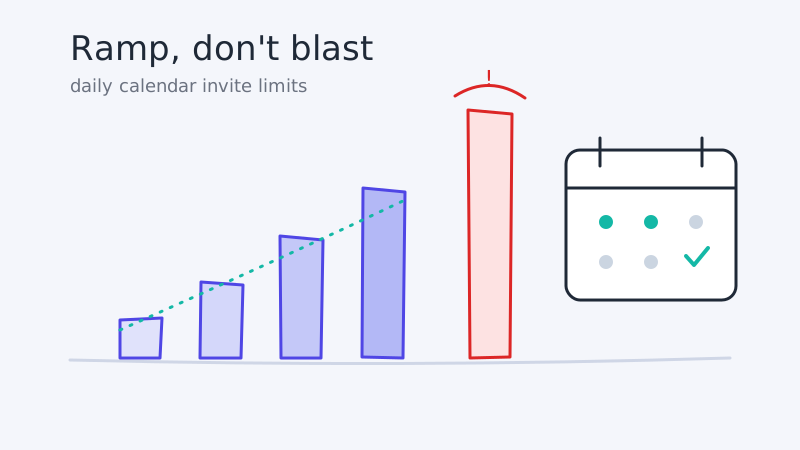
The question comes up the moment a team sees how well cold calendar invites perform: if acceptance rates are this good, why not send a thousand a day? The honest answer is that volume is the fastest way to throw away the advantage. An invite that gets seen is worthless if the domain sending it is already flagged.
There is no single universal number that works for every sender. But there is a defensible range, and there is a way to ramp into it without setting off the alarms that bury cold outreach. This post walks through both.
Invites ride on email infrastructure, so email limits apply
A calendar invite reads as a meeting request to the recipient’s mail client, which is exactly why it sidesteps the promotional filtering that catches bulk email. We have covered that mechanic in detail in do cold calendar invites land in spam.
But the invite still leaves your mail server, travels over your sending domain, and counts against your sender reputation just like any other message. So the throughput limits that mailbox providers enforce on email apply to invites too. Gmail, Outlook, and the rest watch how much a given domain and IP send, how fast that volume ramps, and how recipients react. None of that machinery cares that the payload happens to be an .ics event instead of a marketing template.
That means the daily ceiling is set by your infrastructure, not by the invite format.
A safe daily range by mailbox age
Treat these as ramp targets per individual sending mailbox, not per domain. The newer the mailbox, the lower the ceiling.
- Brand new mailbox (week 1 to 2): 5 to 10 invites per day. This is warmup territory. You are teaching the provider that real humans engage with mail from this address.
- Warmed mailbox (week 3 to 6): 20 to 30 invites per day. Increase by roughly 5 a day, not in jumps.
- Established mailbox (2+ months, clean history): 40 to 50 invites per day as a comfortable cruising volume.
If you need more than 40 to 50 sends a day, the answer is more mailboxes, not a higher ceiling on one. Five established mailboxes sending 40 invites each gives you 200 a day with far less risk than one mailbox straining at 200. Spreading volume across mailboxes and domains is the single biggest lever serious senders pull.
Why blasting hurts even when the invite lands
It is tempting to assume that because invites get accepted, volume is harmless. It is not, and here is the mechanism.
Mailbox providers score a sender on patterns over time. A domain that goes from zero to 300 sends in a single afternoon looks automated, regardless of what those messages contain. Once the provider decides a domain is behaving like a blaster, it starts throttling, and throttled mail is the mail that quietly lands in spam or gets deferred. By the time acceptance rates drop, the reputation damage is already weeks deep and slow to repair.
There is also the bounce problem. Every invite sent to a dead or mistyped address is a hard bounce, and a cluster of hard bounces is one of the loudest negative signals a domain can send. High volume multiplies this risk because you are simply mailing more addresses before you have verified any of them.
Protect the ceiling by mailing a clean list
The daily limit you can safely sustain is partly a function of how clean your list is. A list full of invalid addresses forces your real ceiling down, because bounces eat into the reputation headroom you would otherwise spend on volume.
Running your list through a verification pass before you send removes the dead addresses that would otherwise bounce. Tools like Scrubby catch invalid and risky mailboxes, including the catch-all and hard-to-verify addresses that trip up lighter checkers, so your invites only go to inboxes that actually exist. A verified list lets you sit at the top of your safe range instead of throttling yourself down to absorb bounce risk.
This is the highest-leverage step most teams skip. Clean the list first, and every other number in this post gets easier to hit.
Throttling rules that keep volume safe
Daily totals are only half the story. How you space sends within the day matters just as much.
- Spread sends across the working day. Drip invites over several hours instead of firing the whole batch at 9am. A natural cadence looks human; a single burst looks scripted.
- Add small random gaps between sends. Identical, perfectly timed intervals are a fingerprint of automation. Vary them.
- Respect the recipient’s time zone. Sending a wave of invites at 3am local time signals a bot. We dig into this in scheduling cold calendar invites across time zones.
- Ramp down on bad days. If bounces or declines spike, cut volume for a day or two rather than pushing through. Reputation recovers faster when you back off early.
A platform built for invite outreach handles most of this for you. Kali paces sends, distributes volume across mailboxes, and keeps each address inside its safe daily window so you are not manually babysitting send timers in a spreadsheet.
A simple rule of thumb
If you remember nothing else: ramp slowly, cap each mailbox in the 40 to 50 range, scale with more mailboxes rather than higher per-mailbox volume, and never send to a list you have not cleaned. The teams that burn domains are almost always the ones that treated invite acceptance rates as permission to ignore the fundamentals.
Invites earn you a delivery advantage. Volume discipline is how you keep it.